
Ajit Mishra, vice president, Research, Religare Broking, answers your queries.

Fund inflows jumped over 77 per cent in the second quarter of 2021 to $7.55 billion compared to $4.26 billion in the first quarter, according to the data collated by Refinitiv, the London Stock Exchange Group's financial markets data and insights arm. However, volume growth was a tepid 8.8 per cent in Q2 at 296 transactions up from 272 in Q1, totalling the counts in the first half to 568, against 365 transaction in the year-ago period. Total inflows in the first half of 2020 were $5.43 billion across 365 deals, while in the first quarter these were $3.92 billion across 183 deals and the second quarter at $1.51 billion across 182 deals, according to Refinitiv.

Imports too contracted by 28.72 per cent to $31.16 billion. Dip in exports and imports narrowed the trade deficit -- the difference between imports and exports -- in March to $9.76 billion, the lowest in the last 13 months.

Bank credit growth declined to 8.5 per cent in January from 13.5 per cent in the year-ago period.

The country's exports grew by 47.19 per cent to $35.17 billion on account of healthy growth in the outbound shipments of petroleum, engineering, and gems and jewellery, according to the provisional data of the commerce ministry. Imports during the month also rose by 59.38 per cent to $46.40 billion, leaving a trade deficit of $11.23 billion. Exports of petroleum, engineering, and gems and jewellery in July increased to $3.82 billion, $2.82 billion and $1.95 billion respectively, the data showed.

Fresh capital raised by companies by way of initial public offerings (IPOs) is set to hit a 14-year high, thanks mainly to Zomato's maiden offering. India Inc has raised about Rs 19,300 crore in fresh capital by maiden offerings, including the Rs 9,000 crore the food delivery company will raise this week, so far in 2021. The best year in terms of fresh fund-raise was 2007, when companies had raised Rs 32,102 crore. With Paytm planning to issue fresh shares worth Rs 12,000 crore, the domestic market looks set to surpass that tally this year.

The manufacturing sector, which constitute more than 77 per cent of the index, recorded a growth of 5.2 per cent in April, up from 2.9 per cent in the year ago month.

Billionaire Mukesh Ambani-run Reliance Industries Ltd's retail arm on Thursday raised Rs 9,555 crore from Public Investment Fund (PIF) of Saudi Arabia, taking total fundraise in the last two months to Rs 47,265 crore. PIF will take a 2.04 per cent stake in Reliance Retail Ventures Ltd (RRVL), the Indian firm said in a statement. The investment values RRVL, the retail arm of Reliance Industries Ltd, at a pre-money equity value of Rs 4.587 lakh crore.
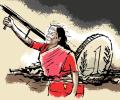
The number of centrally sponsored schemes have increased to 35 in FY22 from 30 in FY21 and central sector schemes have increased to 704 from 685 in the previous year, reports Dilasha Seth.

'It is just an excuse to say that the Centre has run out of money.' 'Pruning these schemes would mean hard time for the people of India.'

India's industrial production grew by 1 per cent in December, official data showed on Friday. According to the Index of Industrial Production (IIP) data, the manufacturing sector output grew by 1.6 per cent in December 2020.

Nikunj Saraf, Vice President Choice Wealth, answers your mutual fund queries.

IT services major Wipro on Wednesday posted an about 21 per cent increase in consolidated net profit at Rs 2,968 crore for the December 2020 quarter. The net profit attributable to shareholders in the year-ago period was at Rs 2,455.9 crore, according to a regulatory filing by Wipro. Its revenue from operations grew nearly 1.3 per cent to Rs 15,670 crore from Rs 15,470.5 crore in the quarter ended December 2019. Wipro, which gets a bulk of its topline from IT services, said it expects revenues from that business to be in the range of $2,102 million to $2,143 million in the March 2021 quarter.

On the Sensex chart, IndusInd Bank, SBI, Dr Reddy's, NTPC, ICICI Bank, HCL Tech and Bajaj FinServ emerged as major laggards.

Bolstered by bullish investor sentiments, India witnessed companies mopping up a whopping $9.7 billion through initial share sales in the first nine months of 2021, the highest amount for the nine-month period in two decades, says a report. As many as 72 initial public offerings (IPOs) hit the stock market during the January-September period this year in India and strong sentiments were visible in the global markets as well, according to leading consultancy EY. EY, in its latest report, said the global IPO market continued to boom through Q3 2021 resulting in the most active third quarter by deal numbers and proceeds in the last 20 years.

Smaller stocks continue to shine at the bourses. The BSE MidCap index is up 18 per cent since the beginning of January this year against a 5 per cent rise in the Sensex during the period. With the current rally, the mid-cap index has doubled in value since the end of March 2020 against a 70 per cent rally in the Sensex during the period. On Tuesday, the mid-cap index closed at 21,232, as compared to 17,941 at the end of December 2020. In the same period, the benchmark index moved from 47,751 to 50,193.

Why are investors gung-ho about State Bank? asks Tamal Bandyopadhyay.

There are several discussions going around in the e-health sector for consolidation with key players being PharmEasy, 1mg, Medlife and Netmeds. According to reports, Reliance Jio is in talks with Netmeds to acquire the latter.

The price of diesel sold to bulk users has been hiked by about Rs 25 per litre in line with a near 40 per cent rise in international oil prices, but retail rates at petrol pumps remain unchanged, sources said. Petrol pump sales have jumped by a fifth this month after bulk users like bus fleet operators and malls queued up at petrol bunks to buy fuel rather than the usual practice of ordering directly from oil companies, widening the losses of retailers. Worst hit are private retailers like Nayara Energy, Jio-bp and Shell, who have so far refused to curtail any volume despite a surge in sales.

The country's exports dipped 8.74 per cent to $23.52 billion in November on account of contraction in shipments of key sectors like petroleum, engineering, chemicals and gems and jewellery, official data showed on Tuesday. Trade deficit during the month narrowed to $9.87 billion as imports too declined by 13.32 per cent to $33.39 billion.

Retail investors have gained significant heft in the past year amid a sustained uptick in Indian equities. The share of retail investors in companies listed on the NSE reached an all-time high of 7.32 per cent in the quarter ended December 31, 2021, up from 7.13 per cent in the previous quarter and 6.9 per cent a year ago, the data from PRIME Infobase shows. This was despite the Nifty's 1.5 per cent decline during the quarter.

PSBs' gross NPA ratio may decline to 12 per cent by March 2019 in the baseline scenario, whereas private banks' gross NPA ratio may decline from 3.7 per cent to 3.2 per cent in March 2019.

M&M was the top loser in the Sensex pack, shedding over 2 per cent, followed by Dr Reddy's Bharti Airtel, Tech Mahindra, HUL, ICICI Bank and Infosys. NSE Nifty dropped 64.80 points to 14,341.35.

India's traditional companies are now moving full scale into the renewable and alternative energy space that had been dominated by smaller players over the past decade. Companies such as government-owned NTPC and the Adani and the Tata groups restructured their businesses well in time to become major players in the green space. At the same time, other conventional companies, such as Larsen & Toubro and Reliance Industries Ltd (RIL), which have a presence both in the energy sector as well as myriad other activities - construction, technology and retailing - are tying up with new-age companies to hitch a ride to a greener path.

No longer Bengal's finance minister, Amit Mitra, Mamata's principal chief advisor, will still advise and aid the 'chief minister and finance department on all matters relating to management of state finance', represent the 'state government in national and international events/meetings/committees' and examine 'important proposals/files and policy issues relating to financial matters referred to him for advice/views'.

If the earnings in the first quarter of the current financial year are an indication, most banks, particularly those majority-owned by the government, have fared well, reveals Tamal Bandyopadhyay.

Despite the $11.7 billion raised by Reliance Industries Ltd (RIL) through stake sales, venture investments in 2020 have declined by a fifth to $28.9 billion till September, consultancy firm EY said in a report on Thursday. Since mid-March, coronavirus infections started getting reported in the country, which has now become the second highest globally in terms of numbers. The lockdowns severely dented economic activity, leading to a 23.9 per cent contraction in the gross domestic product (GDP) for the April-June period and expectations of a 9.5 per cent contraction by the Reserve Bank of India (RBI) for 2020-21.

ETFs function like a mutual fund scheme and have underlying assets of government-owned companies.

Equity benchmark Sensex tanked over 1,000 points in the opening session on Friday tracking losses in index majors ICICI Bank, HDFC twins and Reliance Industries amid a negative trend in global markets.

Jeswin Aldrin, who had already qualified for the championships, however missed the cut.
If IOC is not allowed to run its own affairs, then we can see it close down in the next 10 to 15 years, warns Sudhir Bisht.

The states were advised to plan for the requisite number of isolation, oxygen supported and ICU beds based on the prevalent and expected case growth rate. the Ministry of Health and Family Welfare is also monitoring the COVID-19 hospital infrastructure, he said.

NSE Nifty finished higher by 46.05 points, or 0.39 per cent, at 11,707.90. Asian Paints was the top gainer in the Sensex pack, rallying 6.32 per cent, followed by Nestle India, HUL, Bajaj Auto, IndusInd Bank, Tata Steel, Maruti and PowerGrid.

With the disruption caused by the second wave of Covid-19 pandemic, the 'fear of unknown' is looming over the government's privatisation drive. Although there is a lot of uncertainty and unpredictability on how things will unfold, the government is hopeful of completing the transactions listed in the Budget with a delay of one to two months, said a top government official. However, "there are many unknown factors now, and we do not know whether there could be a third wave. But we are trying to carry on with our work", the official said." Since there is a lot of uncertainty, the estimates will have to be revised as rating agencies are revising their outlook for growth.

'Rising Covid cases and localised lockdowns are being closely monitored.'

GST collections in March touched a record high of over Rs 1.23 lakh crore, a 27 per cent growth over the year-ago period, the Finance Ministry said on Thursday. "GST revenues crossed above Rs 1 lakh crore mark at a stretch for the last six months and a steep increasing trend over this period are clear indicators of rapid economic recovery post pandemic," the ministry said. Closer monitoring against fake-billing, deep data analytics using data from multiple sources including GST, income tax and customs IT systems and effective tax administration have also contributed to the steady increase in tax revenue over last few months, it added.

The country's manufacturing sector activity recorded another sharp deterioration in business conditions during May as new orders placed with producers continued to fall after April's record contraction, leading firms to cut jobs at the quickest pace on record, a monthly survey said on Monday.

India's second-largest software services company Infosys on Wednesday posted 12 per cent year-on-year rise in consolidated net profit at Rs 5,686 crore for March quarter 2021-22. The Bengaluru-based company had registered a net profit (after minority interest) of Rs 5,076 crore in the corresponding period previous year, according to a regulatory filing. Infosys' revenue grew 22.7 per cent to Rs 32,276 crore in the quarter from Rs 26,311 crore in the year-ago period, it added.

Omkeshwar Singh, head, Rank MF, a mutual fund investment platform, answers your queries.

We have not suffered such huge price shocks across so many basic commodities, at the same time, in decades. Has the inflationary impact of all this been factored into stock prices as yet, asks Debashis Basu.
 © 2026 Rediff.com - Advertise with us - Disclaimer - Privacy Policy - Sitemap - Feedback - About us - Terms of use - Grievances